
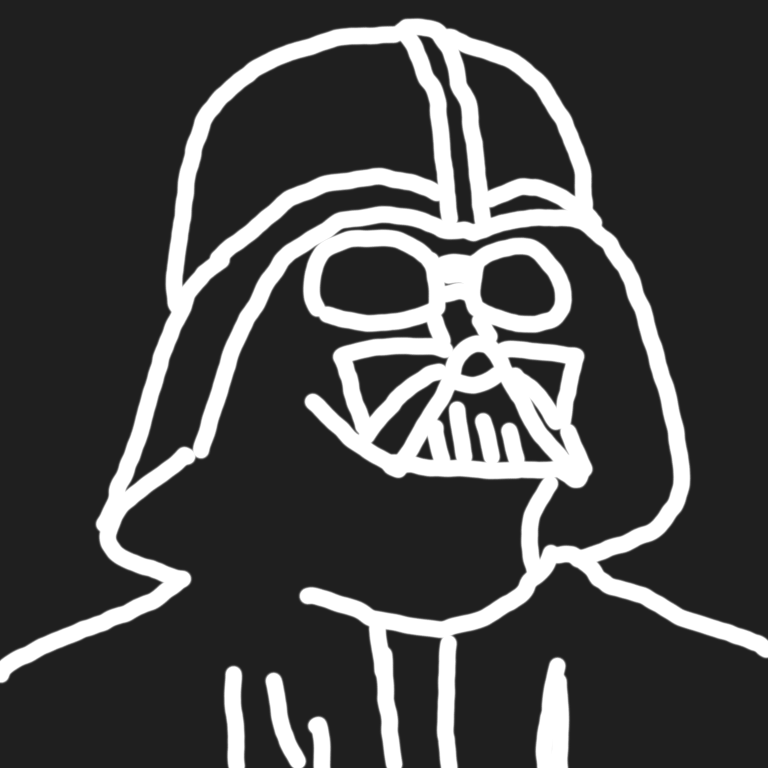
Star Wars If Only Star Wars
What would you do with Star Wars if all you had to work with was the original film released in 1977?
By: TheHans255
1/29/2026
Say that, through some freak accident or alternate timeline, the only piece of media in the sprawling, decades-long Star Wars space opera franchise is the original 1977 film, complete with its year-plus-long theatrical run and the widespread audience acclaim that it got; and that you are now in control of the direction of the Star Wars franchise. Where would you take it?
This is a question I've had in the back of my mind for a bit. The reason it's so fascinating is because, unlike the sequels, prequels, and eventual full media empire that would fill the Star Wars franchise with its extensive worldbuilding, intertwined storylines, massive cast of characters, and more (for better and worse), the original Star Wars movie is a very straightforward, simple, and self-contained film by comparison, establishing the core of the Star Wars world and leaving the rest of it wide open. From that foundation, and that fanbase that you gathered from that first film, there are simply so many ways the story can go that can be difficult for someone so steeped in the current Star Wars lore to even imagine - some of the decisions that Star Wars would make, of course, are wonderful and contribute to excellent filmmaking, while others are more debatably so, and it's worth considering simply how different the story could be.
To start our journey, let's begin by considering the monologue that Obi-Wan Kenobi (aka Ben Kenobi, played by Sir Alec Guinness) gives to Luke Skywalker (the main protagonist, played by Mark Hamill), as he presents Luke his father's lightsaber and explains the history of the Jedi Knights:
BEN: I have something here for you. Your father wanted you to have this when you were old enough, but your uncle wouldn't allow it. He feared you might follow old Obi-Wan on some damned-fool idealistic crusade like your father did.
... LUKE: What is it?
BEN: Your father's lightsaber. This is the weapon of a Jedi Knight. Not as clumsy or as random as a blaster. An elegant weapon, for a more civilized age.
For over a thousand generations the Jedi Knights were the guardians of peace and justice in the Old Republic. Before the dark times, before the Empire.
LUKE: How did my father die?
BEN: A young Jedi named Darth Vader, who was a pupil of mine until he turned to evil, helped the Empire hunt down and destroy the Jedi Knights. He betrayed and murdered your father. Now the Jedi are all but extinct. Vader was seduced by the dark side of the Force.
LUKE: The Force?
BEN: Well, the Force is what gives a Jedi his power. It's an energy field created by all living things. It surrounds us and penetrates us. It binds the galaxy together.
This is the first the film and the franchise gives us of the history of the Star Wars world beyond the immediate past - "before the dark times, before the Empire". The Star Wars franchise that we got in our present timeline adds the following details to this monologue:
- First, in one of the most famous twists of movie history, Episode V reveals that Darth Vader and Luke's father are in fact one in the same person, and that this monologue on its face is a lie. Episode VI goes on to have Obi-Wan say that it is only true "from a certain point of view", in that Luke's father symbolically killed his old identity and fully embraced that of Darth Vader.
- In addition, as depicted in Episodes I-III, it is revealed that the Jedi and the Old Republic were thriving just decades before the events of Star Wars, and the Jedi Knights were wiped out in one fell swoop due to "Order 66", a secret command programmed into the minds of every member of the Clone troops used by the Republic; Darth Vader, as newly christened by the budding Emperor, killed most of the remaining stragglers, including the children in training.
But wait. That timeline feels a little fast, doesn't it? We've got a whole galaxy of planets ruled by an Old Republic for tens of thousands of years, that is replaced in all but a few months by an all-powerful and tyrannical Galactic Empire, only about twenty years before the events of the film. Admittedly, a sudden political turnover that converts a Republic to an Empire is actually rather plausible, but more poignant is the fact that no one other than Obi-Wan or the Empire itself seems to know anything about the Old Republic. The people of Luke's home planet of Tatooine don't mention the Republic (yes, they're in the sticks, but if they know about the Empire, you'd at least expect an older local to compare them to how the Republic would have treated them). Interplanetary smuggler Han Solo (played by Harrison Ford) doesn't mention the Republic, even when he discusses having to jettison his cargo at the first sight of an Imperial cruiser. And the Rebel Alliance, in their pivotal rebellion against the Empire, might be expected to call itself the Old Republic or even the New Republic fresh off a turnover like this, and yet they never even mention the Old Republic.
Instead, the most obvious reading I get from Obi-Wan's monologue is that he is referring to an Empire that has existed longer than living memory. The Old Republic had long been replaced by the Empire, even if only for maybe one to two hundred years, and the order of the Jedi Knights, no longer supported by the Old Republic, was in a natural decline, to the point where the rebellion of a single pupil, Darth Vader, was enough to locate and eliminate most of the Jedi Knights that were left.
This is, of course, purely a mistake of the prequel films, which were interested in showing a bustling, lively world where late-90s and early 2000s CGI made more sense and lightsaber duels abounded. And again, there are certain ways you can justify this interpretation of the history of the Jedi. But what kind of film could you write about a decaying Jedi order, few in number, quietly practicing their old religion until their pupil betrayed them?
To illustrate another point about that pupil, the infamous and imposing Darth Vader (played in-suit by David Prowse, voiced by James Earl Jones), we can turn to another scene immediately following this one, in which Vader is in conference aboard the Death Star among a group of Imperial generals:
MOTTI: Any attack made by the Rebels against this station would be a useless gesture, no matter what technical data they've obtained. This station is now the ultimate power in the universe. I suggest we use it!
VADER: Don't be too proud of this technological terror you've constructed. The ability to destroy a planet is insignificant next to the power of the Force.
MOTTI: Don't try to frighten us with your sorcerer's ways, Lord Vader. Your sad devotion to that ancient religion has not helped you conjure up the stolen data tapes, or given you clairvoyance enough to find the Rebels' hidden fort--
(Suddenly Motti stops. He begins to choke and starts to turn blue under Vader's spell.)
VADER: I find your lack of faith disturbing.
And then another scene, much later on that same Death Star, when our heroes have already been pulled aboard and Darth Vader is speaking to the commander of the Death Star, Grand Moff Tarkin (played by Peter Cushing):
VADER: He is here ...
TARKIN: Obi-Wan Kenobi! What makes you think so?
VADER: A tremor in the Force. The last time I felt it was in the presence of my old master.
TARKIN: Surely he must be dead by now.
VADER: Don't underestimate the power of the Force.
TARKIN: The Jedi are extinct. Their fire has gone out of the universe. You, my friend, are all that's left of their religion.
In the Star Wars franchise we ended up getting, we are told of the order of the Sith, who stands in competition with the Jedi Knights. Some extended media set in the distant past depict the Sith as a widespread order, but by the time of the film continuity, the Sith have limited themselves to two members at a time, "no more, no less; a Master, and an Apprentice." And, of course, the Chancellor/Emperor is the overarching Master, and after the deaths of two other Apprentices in the prequels, Darth Vader becomes the Apprentice. And indeed, the script to the original Star Wars refers to Darth Vader as a "Dark Lord of the Sith".
However, the word "Sith" is never uttered on screen. While the order of the Sith is certainly in line with how the original Star Wars film presents itself (and TBH a plot point of the saga that I quite like, more than the overnight takeover of the Empire and subsequent amnesia about the Republic), Occam's Razor suggests yet another interesting reading of these scenes: Darth Vader is a Jedi heretic.
That is to say, rather than Darth Vader marking himself as separate from the Jedi religion and joining a darker order, Darth Vader continues to consider himself a Jedi, and continues to revere the Force. Even after betraying and murdering the Jedi Knights and becoming an elite soldier of the Empire, Vader still considers himself one of those knights and believes that what he is doing is right.
And why wouldn't he? He has thoroughly mastered the Force. The invitation to a distinctly different order, with its own distinct name, makes the most sense if he was invited to that order by another person (in this case, the Emperor). But if he instead discovered the dark side of the Force on his own, going beyond simple mind tricks and using the Force to fight and control his enemies, he would have no reason to change the name of his order, instead convinced that everyone around him must change to understand the awesome power that the Force has given him.
Here's another point from the original films about the presentation of Vader. It is not until Episode V that we get any hint of what Darth Vader looks like under his iconic black suit - we see him inside of a closed meditation chamber with his helmet off, facing away from the viewer, and the glimpse we get of the back of his head tells us that he has been severely disfigured, likely needing the suit to survive. Episode VI confirms this, as Darth Vader is mortally wounded and asks Luke to take his mask off, and he indeed dies moments later without the aid of the suit's breathing apparatus.
The original film gives us none of this. It is not established at all that Darth Vader needs the suit to survive any more than the Stormtroopers beside him, meaning that any number of reasons for Darth Vader wearing that suit are available.
For the record, I do think that Darth Vader needing the suit to survive is the best way to develop his character. Saying that he simply wears the suit to look intimidating, as is the case for sequel trilogy antagonist Kylo Ren (played by Adam Driver), creates the awkward need to show him more with his mask off in order to humanize him or simply fanservice him to the audience (such as that one scene in The Last Jedi where Kylo Ren is shown with his whole shirt off). Darth Vader is simply too intimidating for that, and reserving the removal of the mask for his inevitable death at the end of the trilogy seems like the best option.
However, there is another interesting idea here: what if Darth Vader wears the suit because he is in fact several different people sharing the Vader persona? Perhaps the remaining Jedi Knights, rather than being betrayed and murdered by a singular Darth Vader, instead devised a plan by which they could still survive, taking turns in the Vader body and sharing their consciousness, settling into a place in the Empire's upper eschelons and avoiding their ire. Possibly they have fully embraced the dark side of the Force, or maybe they're simply biding their time to eventually overthrow the Empire. Maybe Obi-Wan Kenobi is one of the only Jedi who did not join them and was left with the impression that they were all killed, or is so disgusted with the other Jedi Knights' actions that he prefers to believe that Darth Vader killed them. Or perhaps Obi-Wan Kenobi is in on the whole thing and is using Luke to execute on the next phase of a well-laid plan to overthrow the Empire from within.
To pull a bit in a different direction, we can talk about some more minor differences and details that arise from the fact that we are talking about the original 1977 version of the Star Wars film, and not any of its subsequent releases. For the uninitiated, the version of Star Wars that is sold today (also known as Star Wars Episode IV: A New Hope) is not the same as the film originally shown in theaters, but is actually significantly different, with a decent chunk of the original art replaced with dated 90s CGI and some scenes added and changed - that is to say, this modern version of the film is not the film that audiences fell in love with in the 70s and that ran in theaters for over a year and a half. Sadly, the original version of the film is not officially available today, leaving that effort to fan restoration and preservation projects - the Silver Screen edition and 4K77 are restored and digitized film reels and workprints, while Harmy's Despecialized Editions are edits of modern releases that reverse the edits made in the modern Special Edition.
I'm not going to list all of the changes (including "Han shot first", since I don't really think whether Han Solo shot Greedo in response to a verbal death threat at gunpoint or an actual gunshot changes his character all that much), but there are two that do significantly affect how future movies are developed:
- Jabba the Hutt, the mob boss who gives Han Solo smuggling jobs and sends Greedo to him when he fails, does not appear on screen in the original film - a prototype of this scene was filmed and was included in the rough cut, but was not actually part of the film until the Special Edition, when his eventual appearance in Episode VI was rendered in CGI. If we use purely the original Star Wars film as a base, then Jabba the Hutt can still be anything or anyone we want him to be. I have nothing against the slug alien design they eventually went with (especially when it was done with practical effects instead of CGI), but there is still plenty of room for choices here - heck, Jabba the Hutt could also be multiple people adopting a false persona, perhaps as a foil to the "Darth Vader is multiple people" idea above.
- More importantly, the original film is just called "Star Wars" - there is no "Episode VI" designation or "A New Hope" subtitle. The idea to make room for a trilogy of prequel films did not come until the next film, when George Lucas came up with the idea for Darth Vader being Luke's father and wanted to announce his intention to release films illustrating how Luke's father transformed into Darth Vader, and so the original film was edited in 1981 to add these designations. Since, in our hypothetical universe, that film does not exist yet, we have more freedom with how Star Wars can be placed in a wider continuity - perhaps it can indeed be the first film in the series, or we use a different numbered structure for other orders of prequel films. Even if we do use the "I am your father" twist verbatim and announce our intention to do prequel films, we can be more flexible with exactly how many prequel films we do - indeed, one of the major ideas behind the "Machette Order" for watching the Star Wars saga (which suggests watching the films in order of Episodes IV, V, II, III, and VI), is that two films are enough for showing this transformation and Episode I: The Phantom Menace is largely irrelevant.
To round out our discussion, let's talk a bit about the Force itself. In popular culture, the Force is perhaps most famous for its ability to telepathically move objects - a Jedi stretches out their palm and summons their lightsaber from anywhere in the room, for instance, or a Jedi uses the Force to lift rocks or other large objects. The Force is also known for enabling high jumps and other feats of acrobatics, and of course we have the scene at the end of Episode VI where the Emperor (played by Ian McDiarmid) uses the Force to shoot lightning from his fingertips. But these abilities don't actually start appearing until Episode V - in the original Star Wars film, the Force is instead almost entirely telepathic, giving a Jedi both powers to know things outside their normal perception and to influence the thoughts of others, but not giving them much in the way of telekinesis.
- The first time the Force is mentioned in the film is when Obi-Wan explains that Darth Vader was swayed to the dark side of the Force, and clarifies that the Force is what gives a Jedi his power, and that it is an energy field created by all living things.
- As Obi-Wan and the others approach Mos Eisley, and they are stopped by Stormtroopers who want to search their vehicle, Obi-Wan waves his hand and says "These are not the droids you are looking for", and the Stormtroopers immediately repeat "These are not the droids we're looking for" and allow them to pass without a search.
- Luke later does a training exercise with a training drone, which fires shots at him that he is expected to deflect with the lightsaber. After a few rough sets, Obi-Wan tells Luke to do the test effectively blindfolded and to trust his instincts, and Luke has more success with the exercise, afterwards remarking that he could almost see the training drone in his mind.
- When the Death Star is used to destroy the planet of Alderaan, Obi-Wan feels a disturbance in the Force, aware of millions of lives crying out in terror and suddenly slienced in an instant.
- When Obi-Wan boards the Death Star, Darth Vader is able to feel and recognize his presence, and follows that presence to eventually duel with and kill Obi-Wan.
- After Obi-Wan is killed, he continues to communicate with Luke telepathically, telling him to run from the Stormtroopers and return to the ship to escape.
- And finally, in the trenches where Luke flies towards the weakness in the Death Star to bomb it and destroy it, Obi-Wan communicates with Luke to tell him to use the Force to find the weakness instead of relying on his bulky targeting computer, and Luke uses the Force to do just that and successfully bomb and destroy the Death Star while evading the attacks of Darth Vader in his pursuing fighter.
Now, there is a bit of an elephant in the room with trying to claim the Force is only telepathic, since there are two instances in the film where it isn't. The first instance (in fact, the first usage of the Force in the film), in which Darth Vader uses the Force to choke Admiral Motti during the meeting aboard the Death Star. You could probably make a case for this one, since it could either be interpreted as Vader physically constricting the officer's throat, or Vader influencing the officer's mind to prevent him from being able to breathe.
The instance you can't argue for, however, is when Obi-Wan is killed by Darth Vader. Instead of being shown dying normally, Obi-Wan's body disappears completely and his cloak falls to the floor in one piece. This isn't just a case of creative censorship, as the film is more than happy to show the bloody severed arm that Obi-Wan cuts off of the thug at the Mos Eisley Cantina. And moments before his death, Obi-Wan tells Vader, "If you strike me down, I shall become more powerful than you can possibly imagine." Clearly, this is something special that Obi-Wan did, and no matter which way you spin it, this goes beyond simple telepathy. Even if you argue that Obi-Wan was dead all along and he is projecting himself to fight Darth Vader, some telekinesis is still required in order to operate his own lightsaber and clash with Vader's.
There are, of course, still plenty of ways to develop the Force beyond what's presented here. There is a certain charm to how the Force turned out in the franchise we got, with the lightning and the acrobatics and everything. You could also build a pretty solid foundation out of the Force being solidly ESP, including telekinesis, or even with just the telepathy plus whatever is implied by Obi-Wan disappearing. And there are maybe other powers and situations that can be explored too, such as a dark Force user using the Force to control politics, or a droid Jedi tapping into the Force to see through walls and shoot faraway targets.
Wait, did I say "droid Jedi"? And Jedi "shoot[ing] faraway targets"? As in, not using a lightsaber?
Yes, yes, I did.
And that's because in the first Star Wars film, the concept of any particular lifeform being any more or less "Force sensitive" than another is not a thing! Not only are there no "midichlorians" that attach a scientific number to a person's Force aptitude, there is also not much suggestion that being connected to the Force is all that hereditary to begin with - that didn't really come into play until Episode VI, where the discovery that Princess Leia (played by Carrie Fisher) was Luke's twin sister and was therefore vulnerable as someone who was strong in the Force but not trained in it. In the original Star Wars film, the extent of Luke inheriting the Jedi order is limited to inheriting his lightsaber - if Obi-Wan believes that Luke's power in the Force itself is hereditary, he certainly doesn't mention it, and he does not assume any prior knowledge in the Force while training him in it. Rather, the Force is an energy field that is generated by all living things, that surrounds us and penetrates us and binds the galaxy together.
So what if it's something that everyone can feel? Anyone who takes an interest in it and practices it can harness it, allowing it to control their actions and obey their commands? What if anyone, even a hardened scoundrel, a royal princess, a notorious crime boss, an Imperial general, a formidable Wookie, a lonely farm boy, could learn to use the Force, simply by virtue of being alive? And they do not necessarily follow the Jedi order, or any corrupted and heretical version of it, but can use the Force in their own ways, using it to enhance their shots or garner diplomacy or protect their friends or simply to disappear into the shadows.
And don't forget the droids as well. C-3PO, the protocol droid (played by Anthony Daniels), probably does not have much potential with the Force, but that's more because of how neurotic he is, always calculating the odds against success and never taking charge of his fate. But what of R2-D2, the astromech droid (played by Kenny Baker)? That little blue droid that could is the most gung-ho and capable of the bunch, and his initiative drives the whole plot forward. Up until as late as 2005, when Episode III gives us a medical droid that is fully incapable of feeling the Force draining the life of its patient, I would not be surprised if R2-D2's aptitude was described as a connection to the Force. Later installments of the Star Wars franchise gave us other interesting droid characters, such as the bounty hunter IG-88 and the lightsaber-collecting General Grevious, and knowing that they can also wield the Force allows them and others like them to enjoy even further depth and capability.
The Force being made hereditary gave us a Star Wars saga wholly revolving around family dynasties - an immaculately conceived Anakin Skywalker/Darth Vader, his children Luke Skywalker and Leia Organa, and his grandchild Kylo Ren; to say nothing about the reveal that sequel trilogy protagonist Rey (played by Daisy Ridley), originally thought to be a "nobody" who still had aptitude in the Force, turned out to secretly be the granddaughter of the Emperor. However, if the Force can indeed be discovered and learned by anybody, and there is no need to preserve any particular family line, then the universe can flourish in any direction, perhaps even with new stories beginning with people in disparate parts of the galaxy discovering the Force all on their own.
Now, of course, what would I actually do? Truth be told, simply thinking about what I can do is way more interesting, though if I had to pin down what story I might tell with the Star Wars universe, I'd probably start with these:
- I would want the Empire to exist beyond living memory, with the Jedi being a dwindling, secretive order by the time Darth Vader betrays them. I think I would also want Darth Vader to be explicitly a Jedi heretic instead of joining an alternate Sith order (unless I did decide that the Emperor should in fact be a Sith Lord, in which case I would fully embrace the Sith being a thing).
- I would absolutely, absolutely have a droid Jedi. And probably also a blaster wielding Jedi.
- I would probably avoid committing to a trilogy format too early, and may well end up with anthologies and series of varying length. A single prequel movie like Rogue One about the brave heroes who find and intercept the Star Wars plans would likely be in order, as would a single movie about Darth Vader's training and how he came to betray the remaining Jedi Knights.
- If I had the idea of Darth Vader being Luke's father, I think I would go with that, especially if I got the same performance that Mark Hamill gave for Luke learning this from Vader. I would also be OK with the resolution that we eventually got with Obi-Wan's monologue being true "from a certain point of view" - frankly, Star Wars is not the kind of story where the wise mentor should permanently break our trust.
- Leia shouldn't be Luke's sister, though. If we need to resolve the love triangle between him, Leia, and Han in a way that causes Leia to end up with somebody, I would rather it be because Luke makes a heroic sacrifice and dies while defeating Darth Vader and the Empire.
Honestly, Star Wars is such a popular, all-commanding franchise that so many people love, and so many people have their own ideas of how they might improve it. My boss, for instance, who first saw Star Wars in theaters as a young child and considers it the transformative moment in movie-making, would do Episode V as is and would start fixing things in Episode VI, such as by changing the teddy-bear-like Ewoks on Endor to be decidedly more ferocious, perhaps having them be more agile and resemble racoons, or having them straight up be Wookies. My father, who's about the same age and also saw Star Wars in theaters, has always been bothered by how Imperial Stormtroopers are described as having precise aim yet can't seem to hit the broad side of a barn in practice; he would want to justify this and make it explicitly a power of the Force to draw fire away from oneself, to the point where the Empire knows that the Jedi have resurfaced precisely because the Stormtroopers are reporting failures to hit their shots. My older brother, who was born shortly before the prequels came out and is a huge Star Wars nut, would mostly focus on fixes to the sequel films produced by Disney. And my wife, who doesn't have nearly as much love for the franchise but does like a lot of the actors in it, would leverage Carrie Fisher's writing talent and put her in the writers' room for future installments.
How would you develop Star Wars? Either with this hypothetical of having just this movie at your back, or any other way you can think of? Feel free to write your thoughts and submit a Webmention below!